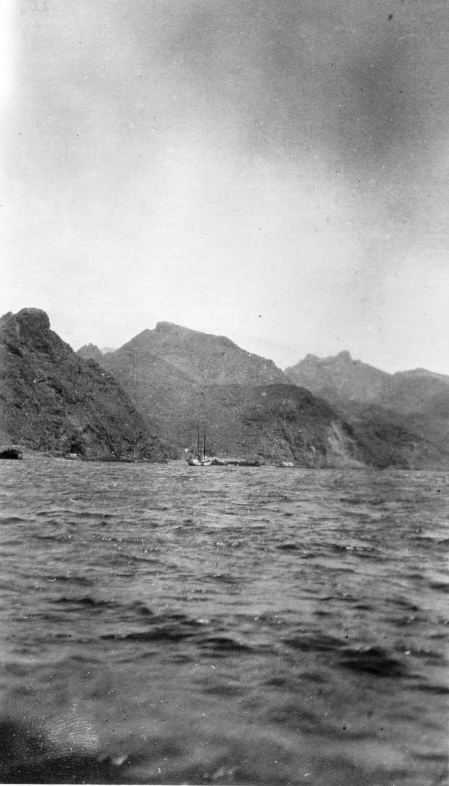
Monday August 14, 1922

Our mealtimes now conform to tropical custom: we have breakfast at 7 AM, chop (lunch) at 12 noon, then rest till 2pm when we have tea, ending with the evening chop at 7 PM. We retire much earlier than at home.

Most of the day was spent on necessary attention to the arranging of our baggage however in the evening we got in some tennis at the Hardcourts of the mission.

It is possible to discard ones helmet here by 4.30; getting nearly 2 hours of tennis between then and dark. Very enjoyable it is to feel a racket once again.

It is with feelings of perspiration that one watches the native boys playing football in the middle of the day, even in the hot sun but their skin awards them practically a complete protection against the sun by reason of the black pigment it contains.

I saw a native the other day; on his forehead was a patch of skin when no colour had developed leaving it just as pink as ours. An Albino is a person who has no pigment anywhere not even in the eye.
Read More

Sunday August 13, 1922

Our first Sunday in Congo.

Kinshasa being a cosmopolitan city there are many services in the church in different languages for various classes of people Thus one of my earliest experiences this morning was hearing lusty singing from the chapel near our hostel.
The words were in a strange language but the tune was the same as we are accustomed to at home and it seemed very significant and caused me quite a strange feeling as I recognised the hymn as “O happy way that fixed my choice”... We have seen enough to realise that happiness for the native can come by no other way.

There was an English service at 11 AM where Rev. Davies preached. Some of the men from Levies (H.C.B) were present. Davies was doing great work in presenting Christianity in - to them - a new light.


In the afternoon we went to a service in the native quarter of the town and had our first experience of an African congregation.


In the evening we went for a little walk by the river and came upon a host of driver ants on the march. These ants move in an orderly column like an army on the march. they advance in rows of five or six abreast like a little stream of brown water. They take hours to pass a given spot, which gives some idea of the millions of ants in one colony. They have officers - a larger ant all together with formidable pincers - who walk outside the column or stand in places of difficulty or danger lining the route on either side. They also use their pincers to “stimulate” slackers: when one of these offices really gets a grip of one's finger they will never let go, they will let you pull them in half rather than slacken their Bulldog grip.
Driver ants are the enemies of the termites (or so called white ants) it is the termite which is the greatest enemy of man’s goods in the tropics; so the drivers must be regarded as friends. Termites will eat wooden boxes, books, clothes or anything - except metal. Fortunately then driver ants eat termites!


I had dinner with the Reverend Davies; we had some familiar hymns and anthems after chops.
From the veranda we could see large bush fire on the hills across the water.

It has been sunny and hot today; the warmest day we have had so far, but cool this evening. Even so it has been no hotter than last summer in England, as yet we've had no weather hotter than we have experienced in England.

Last month two sudden deaths occurred at Kinshasa: The wife and son of Mr Haslyn. The little boy got a septic throat which the mother subsequently contracted - both died very soon after onset.

Read More

Saturday August 12, 1922

We reached Thysville last night at around 6:00 pm - Just in time to get settled in before dark which falls soon after. The last part of the line before Thysville is again through mountainous country but very wooded and thus contrasts with the ruggedness of those along Matadi. We saw some wonderful expanses of hills; tier upon tier against a background of blue mountains on the sky line.

The line takes some remarkable curves here: in one place making a complete S bend - almost a figure of 8 where the train goes about a mile and advances just 50 yards or so: all the energy being spent on getting to a higher level.

Thysville lies 2,400 feet above the sea and is about 120 miles from Matadi (100 feet above sea approximately) this gives some idea of the climb up.

We have put up at the Mission at Thysville. Mrs Jennings is a most charming hostess and did everything for our comfort. I went into the little church adjoining the mission houses to see the organ given by the Ropeholders to the station.

We have another early rise tomorrow so we retired early. I shared a bedroom in the visitors house with Rev. Davis. During the night a rat ran off with our candle! Fortunately he made so much noise under the bed whilst devouring it that we were able to rescue it and place it and the soap in one of our trunks for safety. He also visited Rev. Davies bed but gave me the cold shoulder! Rev. Davies assures me in all his experience of the Congo this is the first time he has come into such close contact with rats! One very quickly gets used to these little interruptions however and does not mind them.

Thysville is a large railway centre and has many sidings and sheds as one of the smaller railway centres of some of the home railways.
It is a mark of Congo's development.

On our railway journey we passed some modern cement factory in the course of construction in a native village called Lukala. Germans are said to be assisting in the work: anyway the enterprise is is worthy of them and this is but another illustration of the opening up of Congo's resources.

We bought some bananas and other fruit on the way. A huge bunch of bananas - as much as one of us could manage to carry for 2p!

We left Thysville railway station at 7:00 am and continued our journey much as we did yesterday. Yesterday was cloudy and cool: today is sunny and warmer but not oppressive. In Congo we welcome a cool day as much as we appreciate a sunny day at home.

Thysville is rather more than half way: thus we reached Kinshasa at 4:30 pm. Three Ford lorries were at the station to convey our luggage (and some of the men folk too) to the RMS station where we cleansed, fed and rested ourselves.

The cleansing  was not so lengthy a matter as we had been led to expect from reports of other travellers who had warned us about the "minor horrors" of the Congo railway. Indeed old travellers on our train confessed they had never had a more expeditious journey or one more free from dirt - "why" said Rev. Palmer "not even one of us had any of our clothes damages by hot wood cinders or coal from the engine!" The railway burns coal as long as it lasts and then wood. As a consequence frequently the train does not reach Thysville till long after dark.

Kinshasa is a large modern city and contains the advantages and disadvantages of a large centre of civilisation attracting to it a great numbers of natives from all parts of the colony and beyond. It is to many an African family away up country what London was to the country families of England in the Victorian era: The place where a few do well but the majority degenerate.

The city is divided into two parts - white and black living in separate areas: A large park will eventually separate these two parts. A good deal of shipping is done and motor cars and lorries are used in land transport. The roads however are nowhere metalled and consist, even in the centre of the town, of dusty (in this dry season) ways - in places little better than farm tracks.

Kinshasa everywhere presents the appearance of being unfinished coupled with the burnt out look due to the dry season the irregular distribution of houses and trading concerns gives a staggering and untidy affect to the city.
But good buildings and electric light compensate for lot when daylight ends at 6 PM every day. There are said to be 1000 white people in Kinshasa of which 3 to 400 are Portuguese. I am told the African native does not always regard a Portuguese as a white man because he is careless of his appearance and lives much more like a native does.


A white man who does not shave and he wears dirty clothes is called a Portuguese regardless of whatever nationality he may be.


Kinshasa is about 800 feet above sea level, the Congo river drops 700 feet between here and Matadi - a distance of some 200 odd miles. At present we are nearing the end of dry season, this is the cool season when the rains begin the atmosphere becomes so charged with moisture that the body has difficulty in getting rid of its perspiration by evaporation as ordinary and this makes the wet humid season the hot and trying one.


The dry cool season corresponds roughly to the English summer and the wet hot one to our own winter, this applies to some extent at Yakusu (the seasons are much less marked at Yakusu as it is in the indeterminate region as far as climate is concerned. Rain occurs at Yakusu routinely all year round but the hot season conforms to southern hemisphere rules.)
also though Kinshasa and Yakusu are on opposite sides of the equator - this is because the heat Equator i.e. line of greatest heat is a good deal north of the geographical one running through the Sahara desert, the rain Equator is also north of the geographical one so that the seasons of both Kinshasa and Yakusu correspond to the world's southern hemisphere and not to the northern where Yakusu really is.


Read More

Friday August 11, 1922

We rose this morning at an unearthly hour before it was light in order to get ourselves and our hand luggage to the station by 6.30 am. As we retired last night at a correspondingly early hour, our rest was not shortened - but this way of living is new and strange to me!!

We reached the station in good time our party of 8. The railway carriages are in shape more like one of our tram cars and each carriage holds twelve persons. There are no separate compartments. Each person has a revolving chair (like an office chair) and a small collapsing table is fitted between chairs. There is a little platform behind where one enters the carriage and a little vestibule and lavatory at the forward end.

Trains normally run twice a week but when a boat is in they run more frequently. We were very fortunate in securing a whole carriage to ourselves (2nd class) and this we retain for the whole 2-days journey. This added greatly to the enjoyment of this section of our travel, which is said to be the most trying part of all. It turned out however to be one of the jolliest bits to date. Mr. Davies was in great form: and what with him and games, eating, sleeping and getting out at stopping places - this time passed quickly enough, if not too quickly!

The railway is in some respects more like a tram line in that the train goes up and down "hills" and round tremendous corners which our trains at home wouldn't look at: We had a splendid little engine and kept a consistent 12-14 mph throughout the day, reaching Thysville about 6.00 pm. In face of delays which sometimes occur this was a very good journey.

The first 20 miles of the railway journey is through the most magnificent scenery: mountains and ground in the extreme. We ran by the side of the river for a short distance and had a close view of the hill on which Stanley camped on the opposite bank. Then we passed close to the place where he landed (on the south bank) when the natives became too hostile on the north side. We then left the river and traveled among the great mountains; towering above each other as far as we could see. The gigantic scale of the scene is what makes the greatest appeal: it is so vast, so awesome. It was no small achievement to lay this rail line - narrow as it is: one wonders what the workmen thought of it all as they laid the metals - or whether they were too engrossed - or used to it - to think anything about it. The sleepers frequently have to be made out of metal as protection against the white ants (termites) who would devour wooden sleepers with relish!

Leaving the mountains behind us we travel over rolling hills of course grass and vegetation with a native village every few miles. We stop frequently to take in water and this gives us the chance to stretch our legs and make the acquaintance of the natives. Rev Ennals has a toy monkey with a mechanical device for moving its head and this greatly interests children and grown ups at every stopping place. Mr Davies with his rollocking ways interests and charms them just as much!


- We have seen some beautifully coloured birds on this journey : like little bits of winged sunshine with all the colours of the sunset included.

- At one stopping place the stoker ran off into the bush (any wild country is called bush whether it is forest or grassland) this was not discovered till the whistle went for the train to depart - at which point the native station master seized a big stick and went after the missing employee! However he soon turned up with a sack of food and we went on merrily!

Another delay was caused by Mr Davies requesting hot water from the engine for our culinary purposes! In this case the attitude of the station master was very different. He came along and explained he would help, that we were getting all we wanted, that the train was waiting to go and we were to be sure to be completely satisfied before taking our seats to allow the train to proceed!

Read More

Thursday August 10, 1922

Matadi
Luggage just before leaving Matadi.
We have secured seats on tomorrows train and therefore spent morning and afternoon reorganising our luggage and getting it conveyed by the mission boys from the store shed to the railway station. 
Only a minimum is allowed in the limited accommodation of passengers carriages – all the big luggage has to go in the luggage van either of our train or the one before – or after: sometimes very much after! Regulations on baggage are just now going through a transition period: the freight for stuff going with the passenger is much more expensive than before, but what is left may not be delivered for 6 weeks or 2 months. Thus we were in somewhat of a dilemma between the calls of economy and of convenience.

Some of our luggage at Matadi station.
We finally compromised; taking 87 packages with us and leaving 28 unessential ones to follow. Even so the nett weight was 3,200 kilos (2kilos – 1lb approx) which filled a whole luggage van (as high as an English rail average size luggage van) and part of one other. If a firm engages a whole van they pay £80. We however, by not asking for a van paid less than £40 for a van and a bit! But that’s what happens out here!

The mission site at Matadi is just outside, but in fill view of the town a little further down the Congo and has a river frontage (except that the state claim 15 yards from the waters edge for itself if necessary.)

The river spears out of Matadi into a kind of lake surrounded by magnificent mountain scenery. 
Just opposite this is a little native village with a native path going away over the hill into the interior. In the distance looking up river we can just see the hill on which H.M Stanley camped before his great march into the interior. The road-way he made up from the beach to the top of the hill – though overgrown – can still be made out, even in the distance.
In the foreground is the modern town of Matadi which has arisen since Stanley’s time.

It has a good sized landing stage where ocean ships can berth. The river here widens out into a kind of pool and gives plenty of room for ships to turn under their own steam. Standing on the ship coming up the river she seemed to fill most of the space between the banks – yet as we look at her now lying close up to the side she seems a mere speck: quite insignificant and puny to how she appeared in the early hours of yesterday morning


Read More

Wednesday August 9, 1922

A lovely moon tonight on Congo waters: just ahead, low – almost over the boat. Waters are all lit up – banks shadowed in dark. Bush fires here and there, in the east a lurid red light but alone all the soft light speaks of calm and peace. Chirps and squeaks of animals on the bank. Tonight is our last night on the ship.
We left Boma at 6.0am for the two hours journey up the river to Matadi. This bit of our of our voyage was in many ways the most interesting so far: the early morning light, the calm, slowly flowing river and low hills – sometimes tree covered on either bank. Gradually the country becomes wilder – trees are fewer – the hills are higher their sides steeper and they rise much nearer the waters edge.

By the end of our first hour we are indeed in a wonderful land. The river is narrow (and must be very deep) the hills are mountainous now and rise right from the waters edge. As we look inland mountain rises above mountain as far as the eye can see. The country is quite wild: a few small trees and bushes in the lowlands – coarse grass and vegetation cling to the mountain sides or else brave the rock face standing gaunt and rugged in the grey light.

It is a land where every prospect pleases and the boats slow progress seems much too fast: the river winds its way in and out among the mountains – now showing in a long stretch ahead of us like some great lake – now turning sharply to the right or left – or so concealing its turn that it seems we must run against yonder mountain – or turn back for there seems no way out until we get quite close up to the bend and a new vista opens out before us.

Just below me on the fore deck a native is sweeping up the rubbish which littered the ship at Boma. He is dressed in a red shirt and trousers and a very old English frock coat quite green with age. He looks an odd figure beside these great mountains of his own country -  a picture of too great a part of Africa: that part to whom civilisation has bequeathed just so much of its possessions as it did not want – just its old dirty clothes.


Where the river makes its greatest curves it has worn away the outside bank and so broadened itself into a great ( and shallower) sheet of water at two of these curves especially the great volume of water swirls round with such force as to set up circular currents which at times become very marked. The larger and more famous one is quite near Matadi and is known as the Devils Cauldron. When the river is high this is a strong circular whirlpool of considerable size – a death trap to any canoe which gets out of control and a danger to a small ship. A steamer would be little affected, but we keep well to the outside – and Matadi comes into view as we round this last bend. A pleasing sight from this distance is the little town at the foot of the great hills.

The Portuguese sailors came up this river sometime around 1482 – long before the days of steamship: they must have been wonderfully skilled in manipulating their little sailing boats to get them right up beyond the site where Matadi now is – passing the Devils Cauldron and all the other difficulty’s of the river until the rapids barred their way.

Mission boat crew at Matadi
We moored alongside Matadi landing stage just after 8.0am and spent most of the morning getting ourselves and our baggage off the ship. We passed all our hand luggage etc. through the customs and went to the Mission House by boat for a meal and rest. returning in the afternoon to the large new customs house near the pier to get all our large baggage through customs. We are not allowed to touch it until this has been done and as it takes some time to transfer everybody’s stuff from the ship to the “Douane” we made good use of the time by eating and sleeping!

We “paraded” after dinner with keys and screwdrivers very much in evidence and wore on our faces a beseeching look as if we were dying to open and unpack everything for the customs officers!! One member of the party even went so far as to unscrew two screws of one of his packing cases and that did the trick: the customs officer before whom we had made our declarations – and incidentally to whom we had paid over 1000 francs as a party – came along and said he would pass the whole 115 cases unopened and unexamined. These we stored in a large shed until they could be put on the railway. 

The staff ordinarily stationed at Matadi were home on furlough. Rev.Gaylon was in charge, he and Christie Davies came down to Matadi to welcome and conduct the party up to Kinshasa.

We spent a most delightful evening  feeling we had “something attempted, something done” retiring in good time after yarning, telling and hearing a larger collection of funny stories than – I think – I have ever heard at one sitting anywhere else.   
Read More

Tuesday August 8, 1922

Chapter 2. The river journey.
The ship was moored at Boma pier by the time we had breakfast and it was not long after that meal that we set foot for the first time in Congo.

 Boma is the present capital (Kinshasa is to be the new capital city) and the boat stays here for 24 hours which gave us the opportunity for a walk on land and a visit to the local post office for a number of things; one or two official and business calls and finally a visit to the British Consulate.


But the great thing today was our introduction to Congo and impressions just crowed in all day – too numerous and too new to be recorded all at once – they will come gradually in subsequent pages.
Up to now our life has changed so gradually that each days new things could be dealt with fairly easily but today everything is so new and so different: so many things come into view all at once; so much is suggested from casual observations, so much can be deduced that I will leave a fuller description of impressions until these have been made deeper and more reliable by more extended observation and better conclusions can be reached by longer experience.


Nearly everything is different form the European standpoint: but not so very different from what I had expected from reading and hearing the experiences of others, but the fact of being here and receiving all these strange scenes through all my senses at the same time instead of through one sense at a time – such as the ear in hearing the noises of the Congo – or the eye in studying peculiarities – this is the thing that gives the feeling of “strangeness” even to the things one expected to find and does find as much as they were expected.

Already problems begin to show themselves
and solutions which seemed possible 
in Europe now begin to dissolve altogether!

It is strange how on matters which we are in “familiar” grounds. If we saw a goat or cat or dog we invariably called it a “Congo” goat, cat, dog etc. A banana tree, a mango grove or an orange tree being essentially tropical never received the label “Congo” because in our little experience it has never been anything else! How easy it is to live in a small world by failing to use the gift of imagination: already our travels have shown that.

Tips:
10 shillings or Belgian Equivalent to cabin steward, same to table steward.
5 shillings to bath steward.
Nominal sum to Band and deck steward.

Note for others:
- Customs dues are paid on board before Matadi: Bring plenty of money.
- At Boma visit British Consul for (voluntary) registration taking British passort with you.
- Customs declaration done on board after Banana. Any examination is made at Matadi – a detailed list of contents of each box, preferably in French is here very useful. 
Read More

Monday August 7, 1922

The Congo River
Awoken by a long blast on the ships system. Jumped out of bed and looked through my porthole.

[My porthole seems to me quite wondrous by now: through it I have seem so many new things, I took this photo of it out of a kind of gratitude to it!]


We were in smooth – I must say – very muddy water which was slowly flowing by – and there across the water was Congo LAND. Flat – covered with trees: a very tangle of trees and undergrowth and ivy – and here and there a little bit of sandy bank. Two or three tree-covered islands were near by.
This was the CONGO at last.

We stopped just a little way up the river and took on a pilot and then sailed up to the place where the ship discharges a quantity of coal. This makes the boat draw less water – a necessity in these shallows near the rivers mouth.
We are now at anchor quite near the left bank of the Congo River some hour and a half’s journey below Boma. All the Luggage has been brought form the hold and makes a litter on the decks. Aft there is much noise from the ship’s tackle unloading coal into a barge alongside – and hardly less noise from the Africans doing the work. These Africans were taken on board for the purpose of getting up the luggage to the decks and of discharging the coal:
They will be working all night.
This morning we underwent various formalities connected with landing and made our declarations for purposes of custom excise etc. Belgian officials seem to have no idea of method or organisation. Everything was muddled through with many times the inconveniences that need have been and with much waste of time which could easily have been avoided with a little forethought and arrangement.
However, we are through all our formalities satisfactorily and are now enjoying our surroundings. Just across the water – on the bank are palm trees falling over each other – a mass of undergrowth filling up the space between the tall trees between which run great thick strands of the tropical African ivy. Beyond we can see some hills: the particular ones we are near seem very like English ones: just the kind one sees in Somerset only rather burnt. I suspect they look familiar to others from other parts of the world just as much as to us.
We are really on Africa’s flat “edge” beyond Matadi we shall start rising up into the great inland plateau.

It has been rather a cloudy day but there was a beautiful pink colouration in the west which showed as the sun went down. After the very brief twilight – the full moon rose out of a bank of cloud in the east  along the dark bank of trees coming to the waters edge - a great round ball, bright orange in colour as it shone through a thin layer of cloud. Faintly the colour was reflected in the Congo waters as a pale, delicate path of glory, inviting us to follow its direction east, into the very heart of Africa and promising us a bright successful journey tonight into the dark continent waiting for the dawn.   
Read More

Sunday August 6, 1922

Lat: 3° 40’S. Lang 5° 55’E. 302 miles traveled.
Yesterday we began to prepare our lists and declaration forms etc. for the Customs officers who come aboard tomorrow, so we really feel we are nearing our ocean journeys end.
We are quite out of sight of land and shall not  reach the coast for another 12 hours – even steaming at 12 miles (knots) per hour, yet all afternoon and evening we have been keeping a very intent look out on the waters for the least change of colour. The waters of the Congo are so vast and enter the ocean with such haste that the current is carried out to sea for nearly 200 miles. At 150 miles from its mouth, the Congo water can easily be recognised by the change in colour of the ocean water from blue and green to yellow: so that we can actually be in Congo waters whilst still in the ocean and beyond sight of land.


During the afternoon some brushwood from the Congo forest washed by the boat and later some seeds: these may have come 100’s of miles for all we know – perhaps from the very heart of Africa: a bit of the Congo coming out to meet us. 
Read More

Saturday August 5, 1922

Lat: 0° 36’S. Lang 4° 56’E. 285 miles traveled.
I forgot to mention the Ladies’ Baptism ceremony yesterday. This approaches more to the church of England ceremony as the men’s did to the custom of the people called Baptists.

Each candidate was led up to Neptune’s representative and sprayed with a scent spray from the front and from behind – at the same moment the ships Captain (when no one of the candidates could suspect such a thing) neatly and deftly slipped a little lump of ice down their necks! He, looking perfectly innocent and seraphic when they turned round. It was most beautifully done and caused much amusement. 

We have had a perfect day today as regards weather. Blue sky, blue sea and a lovely cool breeze. In fact this evening it was too cold to sit in the wind so we sought the protected side pf the promenade deck to sit down.

Just before sunset we passed a small Spanish Island  - used as a convict settlement: Annobon Island, - which really consisted of one huge rock. The side towards us was sheer perpendicular rock towering hundreds of feet almost direct from the sea. The highest peak of the Island was lost in grey and white edged cloud. The whole picture was softened by blue haze to which detail was lost, leaving only the gaunt, rugged outline silhouetted against the sky.
Just to the right of the Island the sun was setting lighting up the sky with a wonderful path of glory. And the sun went down and the stars came out and another great sight revealed itself: Moonlight at sea.

The moon is two days from the full and nearly overhead. It is quite light enough to see by – but it is few who would to do that one would think (and yet hardly anyone comes from the saloon or cabins to see.)

The moon was a clear as clear can be. Fluffy clouds come over it now and again making the picture more wonderful. The white foam shows up brilliantly against the dark sea, but one can just make out that exquisite green edging to the waves – so clear by day but so softened and delicate by moonlight as to be almost mysterious.
I watched for quite a long time on a deserted deck – others tucked into bed: I had to use a Jaeger rug it was so fresh.

Byron was much influenced by water –
In his “Stanzas for Music” he is completely
Under its spell.
The be none of Beauty’s daughters with a
Magic like to thee,
And like music on the waters is thy sweet voice
To me.
When, as if its sound were causing the charmed
Ocean’s pausing,
The waves lie still and gleaming, and the lull’d
Winds seem dreaming.
And the midnight moon is weaving her bright
Chain o’er the deep,
Whose breast is gently heaving as an infant’s
Asleep:
So the spirit bows before thee to listen and
Adore thee
With a full but soft emotion like the swell of
Summer ocean.


Read More

Friday August 4, 1922

Lat 1° 59’ N. Long: 0° 57’ E. 325 Miles traveled.

Today we passed from the northern hemisphere to the southern and celebrated the crossing of the line with all the form and ceremony of maritime tradition inherited from the long unknown past. We had a day of tremendous fun and enjoyment:

 About 10.am King Neptune and his court appeared from somewhere and sat enthroned on the aft deck to preside over the initiation ceremonies for all the novices who had not passed this way hithertofore (with the exception of the Roman Catholic Priests, who looked on but would take no part). Pink or blue starch paste acted as soap which was freely administered prior to the Barbers operations with a huge (wooden) razor. The barbers chair was at the edge of a large sea water bath, 10 feet square and deep of warm water, into which the candidate was tipped as soon as the barber had finished. A ships hose added to the fun both of the candidate in the bath and the onlookers outside. Exit was made from the bath from the bath by which ever side was most convenient – but the water was so nice and the hose so refreshing that many delayed their exit for the purpose of prolonging their enjoyment.

 Great mirth was produced when some candidate tried to pull in with him some member of Neptune’s court!
The ships captain acted as a Sergeant-at-arms or MC to see no limits were overstepped – but there was nothing the most conservative person could take exception to. I could hardly say this mornings ceremony was restricted to the male novices! When all had been duly baptised, Neptune’s court proceeded to turn upon each other and carry through the ceremony on one another. Finally Neptune himself was literally thrown in – I suppose this was the door by which he returned to his domains!

“The Baptism of the Equator” is a very ancient custom. I have not been able to find any plausible account of its meaning or origin. It is practiced most especially on British ships or by British Officered ships and is essentially a British tradition. Beyond that, details are lost in antiquity.
The ships of this Belgian line always carried English Officers (one or more) until a few months ago and that explains the thoroughness of the Belgian ships company in carrying out the ritual. Besides there are practically always Englishmen travelling on these boats who enjoy maintaining a national tradition. A Portuguese passenger was at pains to impress on his fellow travelers that this sort of thing was never done on his nations boats!

A Belgian passenger approached on of the Roman Catholic Priests and said: “The Protestant Reverends don’t mind taking their share in all this; why don’t you?” “Ah” – said he “Ce n’est pas possible” and considered the question closed!  

In this connection it is interesting to note how British customs and procedure in practically all maritime matters has set the precedent for the worlds shipping. Not only in such lesser matters as crossing the line ceremonies, but in the way ships of almost every (certainly European) nation are run on the technical and administrative side. It is British customs and procedure nearly every time. I mentioned these boats had English Officers until quite recently and I understand the same is true of many other nations as well.

Of course there are “local variations” in the ritual, under consideration the details were slightly different from those practiced in the Royal Navy – but they are unimportant except to the scientific investigator – and as the beautiful certificate say with which each candidate was afterwards presented – “Our baptism is valid for all time and all places – with Neptune’s seal upon it, it must be so.

                Personally I felt very much at home – being as I was a Baptist in Bath!
Read More

Thursday August 3, 1922

Lat: 5° 2’ N. Long: 3° 32’ W. 276 Miles travelled.

 We reached Grand Bassam this morning. Far away from the coast earlier in the day we passed a little tiny canoe with one occupant – an African. The canoe must have been about 10 feet long and yet I am told they go up to 10 miles from land into the Atlantic. They are said to be the smallest ocean going craft in the world. Certainly it looked almost like a cork as we passed it!

Three boats paddled by Africans came out to us as we anchored in deep water some distance from the shore. Each man had a paddle looking like a large arrow with a very broad head. The appearance of the boat as it approached (the Paddlers arms and paddles all seemed one) was that of a huge spider crawling on the water!

The passengers who came on board and those who left were transported to and from the little boats in a wooden pannier using the ships tackle (crane) just as luggage and mail bags are hoisted!

There were two English boats lying off Grand Bassam. I think every group of ships we have seen so far has included one or more British ships in its number. It gives one a peculiar pleasure to see a distant ship flying the English flag – and fortunately these ships are plentiful in all the waters of the world.
“…the merchant fleet of the British Empire totals 11,135 ships,
with a gross tonnage of 22,058,112 tons.
the ships of the rest of the world only total 22,372
 with a gross tonnage of 43,108,126 tons. So that one
in every three ships met on the Ocean is British.”

“There are always about 1,000 ships
Of the British register traversing the
trade routes at any given moment and
these trade routes have a length of
                                       80,000 square miles” 
               - Excerpts from two news clippings


We are now sailing in the equatorial waters known as the Doldrums. This region was much dreaded by sailors in the old days before steam ships were known because sailing ships were sometimes becalmed for days or weeks in a perfectly helpless condition.
This is a dull day, with grey sea and leaden sky almost the same colour. There are no waves and the surface of the sea is quite smooth except for the undulations of the Atlantic rollers which heave up and down. One can quite imagine what dread these waters running along the equator had for the ancient mariners. With our steam driven propeller we cannot understand what travelling meant to them in those days. Far out at sea in this belt of water the wind has practically no direction (except upwards!). As we are really fairly near land (though we cannot see it) we enjoy the cool air produced by the land and sea breezes previously mentioned (July 29) while the coal fires send us further onwards.

Indeed we are steadily steaming off the map! At the point where we cross the equator (i.e. 0.0° of latitude) we shall be almost exactly on the Greenwich meridian of longitude 0.0° .
The view from "nowhere"

Thus our “address” will be 0° Lat, 0° Long. The depth of water in this region is 20,000 feet (3000 fathoms). In other words we shall be nowhere! This is the only spot on the Earth of which this can be said, so we are really very privileged in visiting this on our first ocean trip.

“Now a sounding of 3000 fathoms requires seventy-five
minutes for its accomplishment, and the approximate
time of descent will be thirty minutes. The Imagination
grasps more readily the tremendous significance of such
a depth as the wire runs out steadily and rapidly, minute
after minute, for half-an-hour; while the seventy pound lead
plunges downwards from the lambent blues and greens
of the surface waters to the black depths below; while it
passes through a magic world
‘…where the branching coral hives
Unending strife of endless lives;
Where, leagued about the ‘wildered boat,
The rainbow jellies fill and float;
And, lilting where the laver lingers,
The starfish trips on all her fingers’
Thus, the spirit of true romance inspires even such a prosaic
proceeding as sounding the oceanic depths, where strange
creatures flit through the black darkness by the light of their
own phosphorescence; where reigns a stillness like that of the
farthest depths of space, untroubled by the thundering
tempest overhead; where even the dominion of man is still
in evidence, in the stretch of the submarine cable which links
two continents together, hung in catenary curves across the
hollows, or lying half-buried in the ooze of the oceans bed.”
- Excerpt from news clipping.

So far it has been nothing like so hot as I expected. At present it is considerably cooler than much of our home summer weather. There is, however, a moistness in the air that makes one feel perpetually more or less “sticky” – apart from this we have had practically nothing that could be called “trying”.

The clocks are forward another half an hour today.

On a long journey as ours is – 6 weeks or more – we come up against the question:
Why?
Why bother?
Why come?
Why care at all?
The last 3 pages of the Jungle Book (Kipling) suggest a key to the answer (ch. On Her Majesties Servants). It is a Kings Command that Christianity to a man “carries on” with the work, ones not to reason why. It is also a desire – a longing – of a heavenly father that this thing should be done and it would be mean not to.


It is also the word of a Gentleman of the strictest honour: We must go on.
Read More

Wednesday August 2, 1922

Lat: 4° 20' Long: 7° 59'. 360 miles travelled.

We have now finished sailing west and have begun going east. We are therefore now meeting the sun and it necessary to put clocks and watches on. Thus today the interval between breakfast and lunch was shortened by half an hour.

It is interesting how large an importance is given to meals when activity in other respects is curtailed as it must be to some degree on board a ship. Nothing goes by the clock, everything is timed by on meal times. Since the meals are served on the tick of time I suppose all this is merely two ways of saying the same thing!

We are not so isolated as you might imagine when at sea. Periodically there is published on board news from the British Wireless Press – and other countries  - notably France as far as we concerned here – issue similar communiques.

For some part of today we have been sailing within sight of the African coast. We can just make out the long sandy shore and the dark green of multitudes of trees beyond. With the glass one can distinguish the typically tropical trees. The sea dashes on the sand (much as it does at Woolacombe) making a conspicuous white line all along the shore. This sand stretches for hundreds, even thousands of miles. We could follow it from here to the Cape if we cared to!


We cannot see far inland as the ground is not high until one gets a good way inland - that is quite far out of sight. The African continent is rather like an enormous inverted saucer with the addition of a flat edge:  at present we can only see the flat rim. We shall gradually climb the inland plateau as we go up the Congo river, but as we only rise 12 inches (approx.) for every mile we go it seems very flat although we are really (or shall be!) rising steadily all the time.
Read More

Tuesday August 1, 1922


Lat: 7°13” N. Long 13°16”W. 157m to noon.

We are at sea again and out of sight of land. It is necessary for ships to keep fairly far out even when “coasting” as the currents in this region are strong and variable in their direction. With a light one can actually see the course of some of the currents.

Watching the waves formed by the ships bows cutting the water is an endless fascination. On the ship one is “behind” the waves as they break and roll away from us. The water heaps itself up – deep blue in colour – mounts higher, curls over – showing a most exquisite edging of bright green for a moment before spreading itself out in a mass of dazzling white foam on the dark blue surface of the sea, while a shower of spray, blown backwards by the wind makes fairy rainbows of the softest hues. All along the ships sides little tiny wavelets curl and ripple like little children trying to copy the action of some great giant.

This is the 41st voyage of the S.S Albertville.  She weighs 7500 tons. There are 98 first class passengers. The crew includes a number of African Natives.
Read More

Monday July 31, 1922

Lat: 10.8N, Long 15.29W. 342 Miles travelled.

A dull, rainy day – quite a new experience for us! But it makes the weather quite cool – remarkably so for our position and the time of year.

We were about 3 hours late in leaving Dakar. But with increased speed we have made up a good deal of our delay to reach Conakry by 8.0pm tonight thus keeping up to our time table.

It was interesting to reach a port in the dark (it is quite dark by 8.0pm now) though it prevented us from seeing anything of the port except a lights and the dark outline of hills against the sky, faintly lit by the young moon shining through a thin film of cloud.


A motor boat came out and took off the passengers and luggage for this port. We remained at anchor in the harbour for some 4 hours and left again just after midnight and continued on our way.
Read More

Sunday July 30, 1922

At Dakar. Till noon: 207 miles.

We reached here something after 5.0am. I, of course, was where all respectable people should be at that hour, but the slowing down of the ship roused me. I looked through my porthole and had my first view of Africa.


Just opposite was the small rocky island guarding the entrance to Dakar harbour: beyond was the low sandy African coast reaching far far away into the distance till sea, sky and coast line all merged into one another indistinguishably. It was a grey cloudy morning, but a brightness in the east showed where the sun was peeking through the clouds and a faint patch of sunlight water stretched from the distance to the ship.

We sailed slowly into the harbour and dropped anchor. Meanwhile I returned to bed, appearing again at breakfast time!
After breakfast we were fascinated and amused by the diving boys of Dakar (Photo 17) who came out in canoes and would dive most cleverly for coins (or almost anything else) thrown into the water. They balance their unsteady canoes with great skill and dive off almost without rocking the canoe.
They seize the coin in their hand and then use their mouth as a purse for their collection, periodically returning to their canoe to deposit their “earnings”. Sometimes they put the coin in their mouths before rising to the surface, giving the appearance of having caught it in their mouths. There is much friendly rivalry and taunting between the competing canoes which the boys enjoy as much as their spectators lining the ships sides on each deck.
We are delayed here longer than we expected for some necessary repairs to our engines.
We are now in a tropical ship. The transformation is practically complete: the ships officers and (European) crew are now entirely in white so the change is now official. Our party is in white and all the ships fittings pertaining to the tropics have now appeared.
Electric fans are going everywhere in the saloons etc, (each cabin has a fan also) white cotton covers have appeared on chairs, sofas etc. Bright curtains have replaced the darker and heavier blue ones with which we started – and iced drinks are in evidence.
The portholes in the lower parts of the ship are fitted with special “scoops” to catch the air current made by the ships advance – and divert it into the rooms. The top (boat) deck is covered by double awning and most of the passengers are resplendent in in white or khaki with their “lids” on (i.e. with helmets). From now on we must wear our helmets whenever we go out from 2 hours after sunrise to 2 hours before sunset, whether it is cloudy or clear.


We have really begun African life today.

We saw great numbers of porpoises this evening leaping some feet into the air from the sea and falling or diving back with a loud “splosh”. These huge fish were most fascinating to watch and could easily keep up with the ships speed – indeed one or two could have out-run her. I attempted to photograph a group of three as they leaped in the air. They seemed to just be enjoying themselves: quite 20 could be counted within a few seconds, seemingly playing hide and seek among the waves.
Read More

Saturday July 29, 1922

Lat: 17.57 N. Long: 17.30W. 308 miles.

A perfect summer day – and hot! A blue sky, hardly any cloud and a smooth blue sea.
We saw shoals of flying fish today leaping from the water and skimming along its surface in groups and singly for quite considerable distances. To the unaided eye they look almost like sparrows flying until the little streak of white foam marks the spot where they dived again into the sea.

These fish lead an unhappy life:
Leaving the sea for a moment to escape some marine enemy they become the prey of sea birds. But the numbers we saw showed that plenty swim on, in spite of their precarious existence!
Another example of sea life of which we saw was the Argonaut  - a floating shell fish,  fan shaped and of a beautiful pink colour it sails edge up among the waves like a little canvas sail (hence the name). A wave would sometimes knock one flat but it would quickly right itself. They passed singly at intervals of some hundred yards – quite small but very pretty especially with the glass.

The heat caused a curious illusion hardly perceptible with the naked eye but markedly visible with the glass. This was a jagged, uneven appearance of the horizon instead of the perfectly straight line was are accustomed to associate with the skyline at the sea side at home. The appearance is of course just the hot air rising and causing distortion of objects in the distance. This is the same as the “watery” appearances seen on hot days on land, or over the funnel of a steam roller or locomotive.

We passed two big ships today, they seem so companionable when there is nothing else in sight by sea.


Our smoke is drifting away at right angles – that is today eastward as we sail southwards. We can see no land but we are on a level with the Sahara desert and its baking sands which cause (by day) a great upward current of air which draws in cooler streams from the sea and so our smoke is drawn towards the great continent – thus we can feel its presence although we cannot see it. Overnight the conditions are reversed and we shall have a land breeze since the land cools quicker than the sea. The clouds go south (approx.) as at Tenerife. 
Read More

Friday July 28, 1922

Lat: 23.05 N Long: 17.21 W. Distance: 326 miles to noon

There is much about Tenerife which did not come under yesterday’s date which I am gradually recalling. So many fresh scenes and experiences makes it very difficult to give a complete description in any sense of the word.

The variety of animals seen in the streets was remarkable: dogs, cats, goats, fowls, donkeys, mules and camels were among those we saw on our drive. The Kaktus grows abundantly and forms hedges in some places; palm trees gave an added tropical appearance to many of the gardens, oleanders   grew by the roadside and we passed through two avenues of eucalyptus trees. Those latter are especially valuable for pier purposes as they are very resistant to the action of the sea water which causes rot in other woods.

As we left the island it was interesting to note that the clouds were traveling in the opposite direction to our smoke. This phenomenon is due to the circulation of air between the equatorial regions and the poles. Hot air rises and passes northward in the upper layers of the atmosphere whilst cooler air flows southwards from the poles nearer the earth’s surface. Thus our smoke drifted on ahead of us (southward) while the clouds floated gently toward the north.

We have lapsed back into our usual routine today. The sky is cloudy but the weather is fine.
Tonight at 9.0pm there was a concert in the dining saloon suitably transformed for the purpose. The singer (male) had a most beautiful voice; the violinist was good but most of the others were weak. Many of the passengers made this their first occasion of appearing in white (tropical) attire. The boat is gradually changing its appearance as we enter warmer regions: even the stewards and officers are beginning to change (also gradually!): they now appear in white trousers but with their dark blue jackets. It will be a day or two before these are shed and the transformation is complete!

Tonight the sea shows another characteristic of the tropics – little specks of phosphorescence among the foam along the ship's sides looking like little glow-worm lights among the waves. The phosphorescence is produced by a little water animal and is seen where the water has been stirred up by the ships “wash”.


We are travelling faster tonight.
Read More

Thursday July 27, 1922

Tenerife.

Distance travelled 174 miles.
The sky last evening was grey and the sea an unbroken stretch of water.
This morning I was roused from bed by the stopping of the propeller. It was 6.0 am. A week ago today we were conscious of its action: now we have become so accustomed to it that its cessation strikes one immediately as something “new”. I jumped up and looked through my porthole.


Across a stretch of water of the bluest blue and deliciously rippled on the surface rose great mountains of rock rising right from the water’s edge and towering tier upon tier – higher and higher away back into the interior of the island (The highest peak is over 12,000 feet). In many places the mountain sides were bare jaded rock but for the most part covered with coarse vegetation, too far off to be seen in any detail. In the steep-sided valleys between these giant rocks one could just make out the dark green of great woods, flourishing in their protected position. The sun was low down away to the right and shining brilliantly not far above the horizon so that the whole scene was lit up from the side. The effect was really indescribable.
Magnificent
          The morning rose, in memorable pomp,
          Glorious as e'er I had beheld--in front,
          The sea lay laughing…. near,
          The solid mountains shone, bright as the clouds,
          Grain-tinctured, drenched in empyrean light;
          And in the meadows and the lower grounds
          Was all the sweetness of a common dawn –
Wordsworth The prelude book IV.


All the hills and valleys facing east were enjoying the full sunlight and was clear and bright to the smallest detail the unaided eye could make out; all those facing west were in deep shadow – black and indistinct by contrast yet looking magnificent in their mystery, whilst the sharp ridges running down the mountain sides divided the one from the other by a line as clear cut as a knife edge.
I dressed quickly and went to the front of the boat and there before me the town of Santa Cruz was spread out: bathed in the early sunlight with dark blue sea in front and the great rocky mountains behind.

The houses, white, pink, yellows and a host of other shades, flat topped and crowded together made a living interpretation of pictures one had seen of Eastern cities in the Mediterranean or some Syrian town on the sea of Galilee…

-   We breakfasted at 7.0am and went ashore as soon as possible in one of the motor launchers which had come out for the purpose. Securing a Guide we were conducted to two good motor cars on the quay and dividing our party – 5 persons filled each car, away we went.
First to the market to try some of the island's famous fruit and then on for a most delightful drive. It was good to feel the earth under ones feet once more!

The market place was not unlike a corner of that at Barnstaple – with stalls numbered in a similar way – but the people – the waves, the languages and the customs of the market were all so different and therefore, so interesting.

After trying fruit - baskets and all for 2f we went a long winding hill to the former capital of the island: Laguna. Our car was a powerful Overland and the way she went up that hill was good for the soul. It was delightful to be motoring again – and so unexpected (with eyes shut we might almost have been doing some long climb with our good old cars on Exmore). The road was appallingly bad in surface as we know roads but on we flew up and up until we reached the Cathedral of the old town – a rather gaudy Catholic place of little beauty but considerable historic interest. 


Some sort of Morning Prayer was taking place; much mumbling and chanting which could hardly be called musical. I wondered how much the people understood and what benefit they got from a strange tongue and could not keep from feeling how much better they would have done by walking outside over the eternal hills at their very doors – with the great mighty ocean in the distance – away from the crowds and conventions of the life in the narrow streets to be even for a few moments of the glorious dawn:
“Alone with God amidst the mystic shadows the solemn hush of Nature newly born, Alone with Him in breathless adoration in the calm dew and freshness of the morn”.
The Cathedral is dedicated to St. Christopher and as we passed a little later on the return from our drive a military procession formed up in the square and fired a salute in honour of the Saint.

 We returned to Santa Cruz and saw the Cathedral there. Here the guide proudly shows us some English flags captured by the Spaniards from Nelson. Nearby is the sacred cross (whence the town gets its name) brought here from Spain on May 3, 1494. Dispensing the cars we went to the shops and learned the method of bargaining from our Elders in the art!
The shop keepers on principle ask up to twice as much as they are likely to get and the purchasers offer about half what he is prepared to give and gradually the two meet (or hope to!) at some common price somewhere between the two extremes. To watch (and hear) the Palmers (experienced here and well-remembered by the shops people) was an entertainment of the most amusing kind.
I made one or two purchases but have reserved most of any shopping for my journey home (otherwise we would pay duty on entering the Congo to no purpose). I have earmarked one or two choice things to bring back with me.


We returned to the Albertville just after 11.0 and sailed away just before noon giving three blasts on the hooter in salute as we left. We sailed past mountainous coast for the rest of the day but by nightfall we were out in the open sea once more.

It is good to feel these great mountains will wait here for us until our return journey and will look just as fresh and bright and wonderful when we next see them as now and will still be looking so to others all the time which intervenes whilst we are working in the heart of Africa.


Tonight there is a beautiful crescent moon in the west making a faint beautifully mysterious “path of glory” across the great waters. Venus shines close by with a brilliant radiance as we sail away with bows pointing south.   

Read More